How to get mouse cursor position in WPF MVVM applications using Dependency Properties
Very useful StackOverflow link, Mark Green's answer, from which I have borrowed heavily here, with one or two modifications in order to fully work in a Visual Studio 2015 environment.
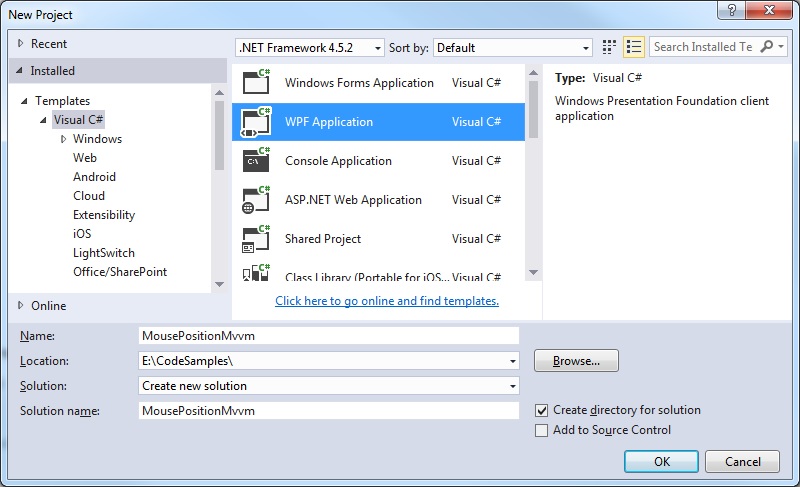
Step 1: Create a new WPF project
 Step 2: Create an example WPF window
MainWindow.xaml
[code language="xml"]
<Window x:Class="MousePositionMvvm.MainWindow"
xmlns="http://schemas.microsoft.com/winfx/2006/xaml/presentation"
xmlns:x="http://schemas.microsoft.com/winfx/2006/xaml"
xmlns:d="http://schemas.microsoft.com/expression/blend/2008"
xmlns:mc="http://schemas.openxmlformats.org/markup-compatibility/2006"
xmlns:local="clr-namespace:MousePositionMvvm"
xmlns:i="http://schemas.microsoft.com/expression/2010/interactivity"
mc:Ignorable="d"
Title="MainWindow" Height="450" Width="525">
<Window.DataContext>
<local:MainWindowViewModel />
</Window.DataContext>
<Grid>
<DockPanel>
<StackPanel DockPanel.Dock="Top" Orientation="Horizontal">
<TextBlock Text="{Binding PanelX, StringFormat='X={0}'}" />
<TextBlock Text="{Binding PanelY, StringFormat='y={0}'}" />
</StackPanel>
<Canvas DockPanel.Dock="Bottom" Background="Aqua">
<i:Interaction.Behaviors>
<local:MouseBehaviour MouseX="{Binding PanelX, Mode=OneWayToSource}"
MouseY="{Binding PanelY, Mode=OneWayToSource}" />
</i:Interaction.Behaviors>
</Canvas>
</DockPanel>
</Grid>
</Window>
[/code]
We will use this window to showcase how the mouse cursor position is constantly read and updated.
Step 3: Create the MVVM View Model class
We will use this class four our X/Y coordinate bindings
MainWindowViewModel.cs
[code language="csharp"]
using System;
using System.ComponentModel;
using System.Diagnostics;
namespace MousePositionMvvm
{
public class MainWindowViewModel : INotifyPropertyChanged
{
private double _panelX;
private double _panelY;
public double PanelX
{
get { return _panelX; }
set
{
if (value.Equals(_panelX)) return;
_panelX = value;
OnPropertyChanged("PanelX");
}
}
public double PanelY
{
get { return _panelY; }
set
{
if (value.Equals(_panelY)) return;
_panelY = value;
OnPropertyChanged("PanelY");
}
}
public event PropertyChangedEventHandler PropertyChanged;
protected void OnPropertyChanged(string propertyName)
{
VerifyPropertyName(propertyName);
var handler = PropertyChanged;
handler?.Invoke(this, new PropertyChangedEventArgs(propertyName));
}
[Conditional("DEBUG")]
private void VerifyPropertyName(string propertyName)
{
if (TypeDescriptor.GetProperties(this)[propertyName] == null)
throw new ArgumentNullException(GetType().Name + " does not contain property: " + propertyName);
}
}
}
[/code]
Step 4: Create an attached behaviour class
MouseBehaviour.cs
[code language="csharp"]
using System.Windows;
using System.Windows.Controls;
using System.Windows.Input;
using System.Windows.Interactivity;
namespace MousePositionMvvm
{
public class MouseBehaviour : Behavior<Panel>
{
public static readonly DependencyProperty MouseYProperty = DependencyProperty.Register(
"MouseY", typeof(double), typeof(MouseBehaviour), new PropertyMetadata(default(double)));
public static readonly DependencyProperty MouseXProperty = DependencyProperty.Register(
"MouseX", typeof(double), typeof(MouseBehaviour), new PropertyMetadata(default(double)));
public double MouseY
{
get { return (double) GetValue(MouseYProperty); }
set { SetValue(MouseYProperty, value); }
}
public double MouseX
{
get { return (double) GetValue(MouseXProperty); }
set { SetValue(MouseXProperty, value); }
}
protected override void OnAttached()
{
AssociatedObject.MouseMove += AssociatedObjectOnMouseMove;
}
private void AssociatedObjectOnMouseMove(object sender, MouseEventArgs mouseEventArgs)
{
var pos = mouseEventArgs.GetPosition(AssociatedObject);
MouseX = pos.X;
MouseY = pos.Y;
}
protected override void OnDetaching()
{
AssociatedObject.MouseMove -= AssociatedObjectOnMouseMove;
}
}
}
[/code]
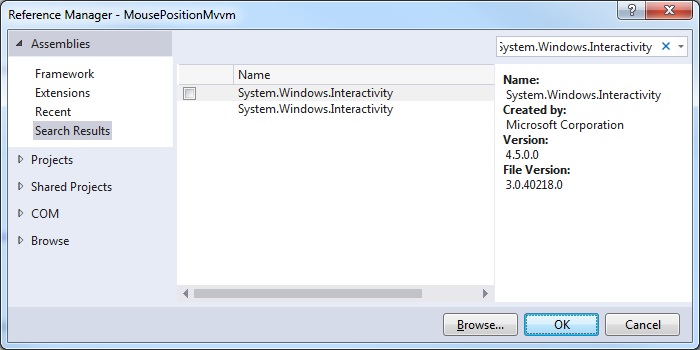
Step 5: Add necessary references
In this example we need to add a reference to System.Windows.Interactivity.
This will allow us to continuously monitor the mouse position as it is being moved around the screen.
Right-click your References folder and select Add reference...
Step 2: Create an example WPF window
MainWindow.xaml
[code language="xml"]
<Window x:Class="MousePositionMvvm.MainWindow"
xmlns="http://schemas.microsoft.com/winfx/2006/xaml/presentation"
xmlns:x="http://schemas.microsoft.com/winfx/2006/xaml"
xmlns:d="http://schemas.microsoft.com/expression/blend/2008"
xmlns:mc="http://schemas.openxmlformats.org/markup-compatibility/2006"
xmlns:local="clr-namespace:MousePositionMvvm"
xmlns:i="http://schemas.microsoft.com/expression/2010/interactivity"
mc:Ignorable="d"
Title="MainWindow" Height="450" Width="525">
<Window.DataContext>
<local:MainWindowViewModel />
</Window.DataContext>
<Grid>
<DockPanel>
<StackPanel DockPanel.Dock="Top" Orientation="Horizontal">
<TextBlock Text="{Binding PanelX, StringFormat='X={0}'}" />
<TextBlock Text="{Binding PanelY, StringFormat='y={0}'}" />
</StackPanel>
<Canvas DockPanel.Dock="Bottom" Background="Aqua">
<i:Interaction.Behaviors>
<local:MouseBehaviour MouseX="{Binding PanelX, Mode=OneWayToSource}"
MouseY="{Binding PanelY, Mode=OneWayToSource}" />
</i:Interaction.Behaviors>
</Canvas>
</DockPanel>
</Grid>
</Window>
[/code]
We will use this window to showcase how the mouse cursor position is constantly read and updated.
Step 3: Create the MVVM View Model class
We will use this class four our X/Y coordinate bindings
MainWindowViewModel.cs
[code language="csharp"]
using System;
using System.ComponentModel;
using System.Diagnostics;
namespace MousePositionMvvm
{
public class MainWindowViewModel : INotifyPropertyChanged
{
private double _panelX;
private double _panelY;
public double PanelX
{
get { return _panelX; }
set
{
if (value.Equals(_panelX)) return;
_panelX = value;
OnPropertyChanged("PanelX");
}
}
public double PanelY
{
get { return _panelY; }
set
{
if (value.Equals(_panelY)) return;
_panelY = value;
OnPropertyChanged("PanelY");
}
}
public event PropertyChangedEventHandler PropertyChanged;
protected void OnPropertyChanged(string propertyName)
{
VerifyPropertyName(propertyName);
var handler = PropertyChanged;
handler?.Invoke(this, new PropertyChangedEventArgs(propertyName));
}
[Conditional("DEBUG")]
private void VerifyPropertyName(string propertyName)
{
if (TypeDescriptor.GetProperties(this)[propertyName] == null)
throw new ArgumentNullException(GetType().Name + " does not contain property: " + propertyName);
}
}
}
[/code]
Step 4: Create an attached behaviour class
MouseBehaviour.cs
[code language="csharp"]
using System.Windows;
using System.Windows.Controls;
using System.Windows.Input;
using System.Windows.Interactivity;
namespace MousePositionMvvm
{
public class MouseBehaviour : Behavior<Panel>
{
public static readonly DependencyProperty MouseYProperty = DependencyProperty.Register(
"MouseY", typeof(double), typeof(MouseBehaviour), new PropertyMetadata(default(double)));
public static readonly DependencyProperty MouseXProperty = DependencyProperty.Register(
"MouseX", typeof(double), typeof(MouseBehaviour), new PropertyMetadata(default(double)));
public double MouseY
{
get { return (double) GetValue(MouseYProperty); }
set { SetValue(MouseYProperty, value); }
}
public double MouseX
{
get { return (double) GetValue(MouseXProperty); }
set { SetValue(MouseXProperty, value); }
}
protected override void OnAttached()
{
AssociatedObject.MouseMove += AssociatedObjectOnMouseMove;
}
private void AssociatedObjectOnMouseMove(object sender, MouseEventArgs mouseEventArgs)
{
var pos = mouseEventArgs.GetPosition(AssociatedObject);
MouseX = pos.X;
MouseY = pos.Y;
}
protected override void OnDetaching()
{
AssociatedObject.MouseMove -= AssociatedObjectOnMouseMove;
}
}
}
[/code]
Step 5: Add necessary references
In this example we need to add a reference to System.Windows.Interactivity.
This will allow us to continuously monitor the mouse position as it is being moved around the screen.
Right-click your References folder and select Add reference...
 Step 6: Try it
Observe how mouse coordinate position is continuously updated:
Step 6: Try it
Observe how mouse coordinate position is continuously updated:
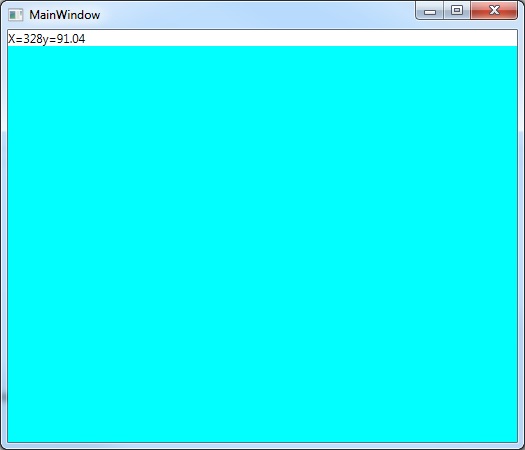 NOTE: this does not have to be a canvas control - it can be any control you like (eg Button) and of any size, so long as this is specified in the attached behaviour class also.
Step 2: Create an example WPF window
MainWindow.xaml
[code language="xml"]
<Window x:Class="MousePositionMvvm.MainWindow"
xmlns="http://schemas.microsoft.com/winfx/2006/xaml/presentation"
xmlns:x="http://schemas.microsoft.com/winfx/2006/xaml"
xmlns:d="http://schemas.microsoft.com/expression/blend/2008"
xmlns:mc="http://schemas.openxmlformats.org/markup-compatibility/2006"
xmlns:local="clr-namespace:MousePositionMvvm"
xmlns:i="http://schemas.microsoft.com/expression/2010/interactivity"
mc:Ignorable="d"
Title="MainWindow" Height="450" Width="525">
<Window.DataContext>
<local:MainWindowViewModel />
</Window.DataContext>
<Grid>
<DockPanel>
<StackPanel DockPanel.Dock="Top" Orientation="Horizontal">
<TextBlock Text="{Binding PanelX, StringFormat='X={0}'}" />
<TextBlock Text="{Binding PanelY, StringFormat='y={0}'}" />
</StackPanel>
<Canvas DockPanel.Dock="Bottom" Background="Aqua">
<i:Interaction.Behaviors>
<local:MouseBehaviour MouseX="{Binding PanelX, Mode=OneWayToSource}"
MouseY="{Binding PanelY, Mode=OneWayToSource}" />
</i:Interaction.Behaviors>
</Canvas>
</DockPanel>
</Grid>
</Window>
[/code]
We will use this window to showcase how the mouse cursor position is constantly read and updated.
Step 3: Create the MVVM View Model class
We will use this class four our X/Y coordinate bindings
MainWindowViewModel.cs
[code language="csharp"]
using System;
using System.ComponentModel;
using System.Diagnostics;
namespace MousePositionMvvm
{
public class MainWindowViewModel : INotifyPropertyChanged
{
private double _panelX;
private double _panelY;
public double PanelX
{
get { return _panelX; }
set
{
if (value.Equals(_panelX)) return;
_panelX = value;
OnPropertyChanged("PanelX");
}
}
public double PanelY
{
get { return _panelY; }
set
{
if (value.Equals(_panelY)) return;
_panelY = value;
OnPropertyChanged("PanelY");
}
}
public event PropertyChangedEventHandler PropertyChanged;
protected void OnPropertyChanged(string propertyName)
{
VerifyPropertyName(propertyName);
var handler = PropertyChanged;
handler?.Invoke(this, new PropertyChangedEventArgs(propertyName));
}
[Conditional("DEBUG")]
private void VerifyPropertyName(string propertyName)
{
if (TypeDescriptor.GetProperties(this)[propertyName] == null)
throw new ArgumentNullException(GetType().Name + " does not contain property: " + propertyName);
}
}
}
[/code]
Step 4: Create an attached behaviour class
MouseBehaviour.cs
[code language="csharp"]
using System.Windows;
using System.Windows.Controls;
using System.Windows.Input;
using System.Windows.Interactivity;
namespace MousePositionMvvm
{
public class MouseBehaviour : Behavior<Panel>
{
public static readonly DependencyProperty MouseYProperty = DependencyProperty.Register(
"MouseY", typeof(double), typeof(MouseBehaviour), new PropertyMetadata(default(double)));
public static readonly DependencyProperty MouseXProperty = DependencyProperty.Register(
"MouseX", typeof(double), typeof(MouseBehaviour), new PropertyMetadata(default(double)));
public double MouseY
{
get { return (double) GetValue(MouseYProperty); }
set { SetValue(MouseYProperty, value); }
}
public double MouseX
{
get { return (double) GetValue(MouseXProperty); }
set { SetValue(MouseXProperty, value); }
}
protected override void OnAttached()
{
AssociatedObject.MouseMove += AssociatedObjectOnMouseMove;
}
private void AssociatedObjectOnMouseMove(object sender, MouseEventArgs mouseEventArgs)
{
var pos = mouseEventArgs.GetPosition(AssociatedObject);
MouseX = pos.X;
MouseY = pos.Y;
}
protected override void OnDetaching()
{
AssociatedObject.MouseMove -= AssociatedObjectOnMouseMove;
}
}
}
[/code]
Step 5: Add necessary references
In this example we need to add a reference to System.Windows.Interactivity.
This will allow us to continuously monitor the mouse position as it is being moved around the screen.
Right-click your References folder and select Add reference...
Step 6: Try it
Observe how mouse coordinate position is continuously updated:
NOTE: this does not have to be a canvas control - it can be any control you like (eg Button) and of any size, so long as this is specified in the attached behaviour class also.


Comments
Post a Comment