Handling mouse events in WPF / MVVM using MvvmLight Event Triggers
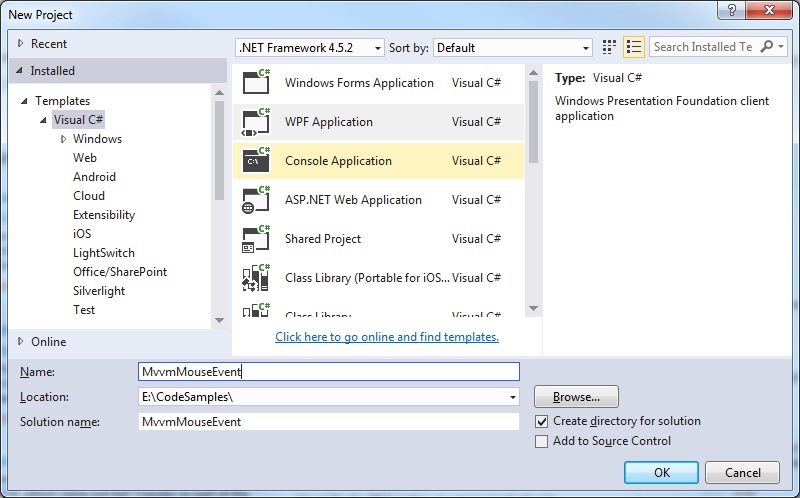
Step 1: Create a new WPF project
 Step 2: Install MVVM Light
Select Tools > NuGet Package Manager
At the prompt type:
[code language="text"]
Install-Package MvvmLight
[/code]
Step 3: Add event handling code
See this link for reference
https://www.technical-recipes.com/2016/using-relaycommand-icommand-to-handle-events-in-wpf-and-mvvm/
Right click your project folder and select Add > New Item > Class to add the following three classes:
RelayCommand.cs
[code language="csharp"]
using System;
using System.Windows.Input;
namespace MvvmMouseEvent
{
public class RelayCommand<T> : ICommand
{
private readonly Predicate<T> _canExecute;
private readonly Action<T> _execute;
public RelayCommand(Action<T> execute)
: this(execute, null)
{
_execute = execute;
}
public RelayCommand(Action<T> execute, Predicate<T> canExecute)
{
if (execute == null)
throw new ArgumentNullException("execute");
_execute = execute;
_canExecute = canExecute;
}
public bool CanExecute(object parameter)
{
return (_canExecute == null) || _canExecute((T) parameter);
}
public void Execute(object parameter)
{
_execute((T) parameter);
}
public event EventHandler CanExecuteChanged
{
add { CommandManager.RequerySuggested += value; }
remove { CommandManager.RequerySuggested -= value; }
}
}
}
[/code]
EventRaiser.cs
[code language="csharp"]
using System;
namespace MvvmMouseEvent
{
public static class EventRaiser
{
public static void Raise(this EventHandler handler, object sender)
{
if (handler != null)
{
handler(sender, EventArgs.Empty);
}
}
public static void Raise<T>(this EventHandler<EventArgs<T>> handler, object sender, T value)
{
if (handler != null)
{
handler(sender, new EventArgs<T>(value));
}
}
public static void Raise<T>(this EventHandler<T> handler, object sender, T value) where T : EventArgs
{
if (handler != null)
{
handler(sender, value);
}
}
public static void Raise<T>(this EventHandler<EventArgs<T>> handler, object sender, EventArgs<T> value)
{
if (handler != null)
{
handler(sender, value);
}
}
}
}
[/code]
EventArgs.cs
[code language="csharp"]
using System;
namespace MvvmMouseEvent
{
public class EventArgs<T> : EventArgs
{
public EventArgs(T value)
{
Value = value;
}
public T Value { get; private set; }
}
}
[/code]
Step 4: Create the ViewModel class for the main window
Select Add > New Item > Class.
MainWindowViewModel.cs
[code language="csharp"]
using System.Windows;
using System.Windows.Input;
namespace MvvmMouseEvent
{
public class MainWindowViewModel
{
private ICommand _mouseClick;
public ICommand MouseClick
{
get
{
return _mouseClick ?? (_mouseClick = new RelayCommand<object>(
x => { DoStuffWhenMouseClicked(); }));
}
}
private static void DoStuffWhenMouseClicked()
{
MessageBox.Show("Mouse click event handled!");
}
}
}
[/code]
Step 5: Update the MainWindow.xaml
Note that MvvmLight (like Prism) also allows us to pass event arguments to the command too.
MainWindow.xaml
[code language="csharp"]
<Window x:Class="MvvmMouseEvent.MainWindow"
xmlns="http://schemas.microsoft.com/winfx/2006/xaml/presentation"
xmlns:x="http://schemas.microsoft.com/winfx/2006/xaml"
xmlns:d="http://schemas.microsoft.com/expression/blend/2008"
xmlns:mc="http://schemas.openxmlformats.org/markup-compatibility/2006"
xmlns:local="clr-namespace:MvvmMouseEvent"
xmlns:i="http://schemas.microsoft.com/expression/2010/interactivity"
xmlns:command="http://www.galasoft.ch/mvvmlight"
mc:Ignorable="d"
Title="MainWindow" Height="350" Width="525">
<Window.DataContext>
<local:MainWindowViewModel />
</Window.DataContext>
<Grid>
<Border Background="Transparent">
<i:Interaction.Triggers>
<i:EventTrigger EventName="PreviewMouseDown">
<command:EventToCommand Command="{Binding MouseClick}"
PassEventArgsToCommand="True" />
</i:EventTrigger>
</i:Interaction.Triggers>
</Border>
</Grid>
</Window>
[/code]
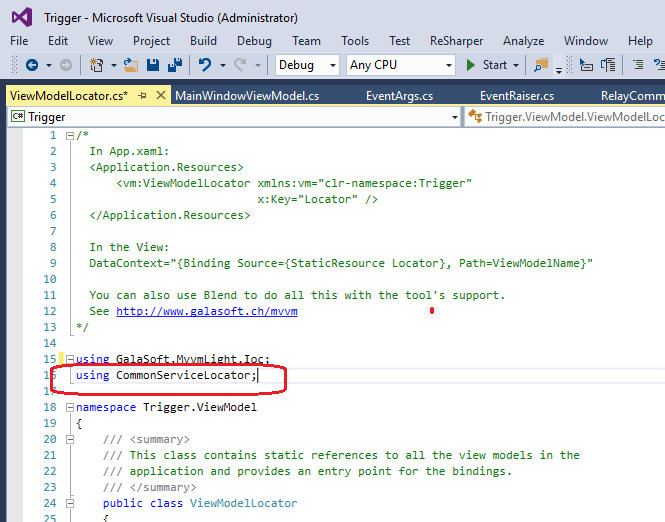
Step 6: Sort out any compiler issues!
On installing MvvM Light, into your Visual Studio project you may get a few compiler whinges.
On my setup, I found that I had to make sure the CommonServiceLocator reference to the automatically generated ViewModelLocator.cs file:
Step 2: Install MVVM Light
Select Tools > NuGet Package Manager
At the prompt type:
[code language="text"]
Install-Package MvvmLight
[/code]
Step 3: Add event handling code
See this link for reference
https://www.technical-recipes.com/2016/using-relaycommand-icommand-to-handle-events-in-wpf-and-mvvm/
Right click your project folder and select Add > New Item > Class to add the following three classes:
RelayCommand.cs
[code language="csharp"]
using System;
using System.Windows.Input;
namespace MvvmMouseEvent
{
public class RelayCommand<T> : ICommand
{
private readonly Predicate<T> _canExecute;
private readonly Action<T> _execute;
public RelayCommand(Action<T> execute)
: this(execute, null)
{
_execute = execute;
}
public RelayCommand(Action<T> execute, Predicate<T> canExecute)
{
if (execute == null)
throw new ArgumentNullException("execute");
_execute = execute;
_canExecute = canExecute;
}
public bool CanExecute(object parameter)
{
return (_canExecute == null) || _canExecute((T) parameter);
}
public void Execute(object parameter)
{
_execute((T) parameter);
}
public event EventHandler CanExecuteChanged
{
add { CommandManager.RequerySuggested += value; }
remove { CommandManager.RequerySuggested -= value; }
}
}
}
[/code]
EventRaiser.cs
[code language="csharp"]
using System;
namespace MvvmMouseEvent
{
public static class EventRaiser
{
public static void Raise(this EventHandler handler, object sender)
{
if (handler != null)
{
handler(sender, EventArgs.Empty);
}
}
public static void Raise<T>(this EventHandler<EventArgs<T>> handler, object sender, T value)
{
if (handler != null)
{
handler(sender, new EventArgs<T>(value));
}
}
public static void Raise<T>(this EventHandler<T> handler, object sender, T value) where T : EventArgs
{
if (handler != null)
{
handler(sender, value);
}
}
public static void Raise<T>(this EventHandler<EventArgs<T>> handler, object sender, EventArgs<T> value)
{
if (handler != null)
{
handler(sender, value);
}
}
}
}
[/code]
EventArgs.cs
[code language="csharp"]
using System;
namespace MvvmMouseEvent
{
public class EventArgs<T> : EventArgs
{
public EventArgs(T value)
{
Value = value;
}
public T Value { get; private set; }
}
}
[/code]
Step 4: Create the ViewModel class for the main window
Select Add > New Item > Class.
MainWindowViewModel.cs
[code language="csharp"]
using System.Windows;
using System.Windows.Input;
namespace MvvmMouseEvent
{
public class MainWindowViewModel
{
private ICommand _mouseClick;
public ICommand MouseClick
{
get
{
return _mouseClick ?? (_mouseClick = new RelayCommand<object>(
x => { DoStuffWhenMouseClicked(); }));
}
}
private static void DoStuffWhenMouseClicked()
{
MessageBox.Show("Mouse click event handled!");
}
}
}
[/code]
Step 5: Update the MainWindow.xaml
Note that MvvmLight (like Prism) also allows us to pass event arguments to the command too.
MainWindow.xaml
[code language="csharp"]
<Window x:Class="MvvmMouseEvent.MainWindow"
xmlns="http://schemas.microsoft.com/winfx/2006/xaml/presentation"
xmlns:x="http://schemas.microsoft.com/winfx/2006/xaml"
xmlns:d="http://schemas.microsoft.com/expression/blend/2008"
xmlns:mc="http://schemas.openxmlformats.org/markup-compatibility/2006"
xmlns:local="clr-namespace:MvvmMouseEvent"
xmlns:i="http://schemas.microsoft.com/expression/2010/interactivity"
xmlns:command="http://www.galasoft.ch/mvvmlight"
mc:Ignorable="d"
Title="MainWindow" Height="350" Width="525">
<Window.DataContext>
<local:MainWindowViewModel />
</Window.DataContext>
<Grid>
<Border Background="Transparent">
<i:Interaction.Triggers>
<i:EventTrigger EventName="PreviewMouseDown">
<command:EventToCommand Command="{Binding MouseClick}"
PassEventArgsToCommand="True" />
</i:EventTrigger>
</i:Interaction.Triggers>
</Border>
</Grid>
</Window>
[/code]
Step 6: Sort out any compiler issues!
On installing MvvM Light, into your Visual Studio project you may get a few compiler whinges.
On my setup, I found that I had to make sure the CommonServiceLocator reference to the automatically generated ViewModelLocator.cs file:
 Step 7: Try it!
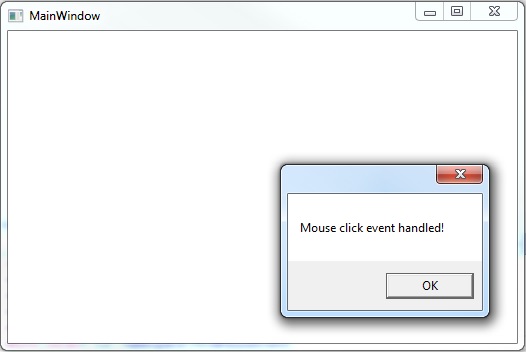
Run the program to see that a bog-standard WPF window is generated. Click anywhere on the area to see that the
mouse click event is handled as requested:
Step 7: Try it!
Run the program to see that a bog-standard WPF window is generated. Click anywhere on the area to see that the
mouse click event is handled as requested:
Step 2: Install MVVM Light
Select Tools > NuGet Package Manager
At the prompt type:
[code language="text"]
Install-Package MvvmLight
[/code]
Step 3: Add event handling code
See this link for reference
https://www.technical-recipes.com/2016/using-relaycommand-icommand-to-handle-events-in-wpf-and-mvvm/
Right click your project folder and select Add > New Item > Class to add the following three classes:
RelayCommand.cs
[code language="csharp"]
using System;
using System.Windows.Input;
namespace MvvmMouseEvent
{
public class RelayCommand<T> : ICommand
{
private readonly Predicate<T> _canExecute;
private readonly Action<T> _execute;
public RelayCommand(Action<T> execute)
: this(execute, null)
{
_execute = execute;
}
public RelayCommand(Action<T> execute, Predicate<T> canExecute)
{
if (execute == null)
throw new ArgumentNullException("execute");
_execute = execute;
_canExecute = canExecute;
}
public bool CanExecute(object parameter)
{
return (_canExecute == null) || _canExecute((T) parameter);
}
public void Execute(object parameter)
{
_execute((T) parameter);
}
public event EventHandler CanExecuteChanged
{
add { CommandManager.RequerySuggested += value; }
remove { CommandManager.RequerySuggested -= value; }
}
}
}
[/code]
EventRaiser.cs
[code language="csharp"]
using System;
namespace MvvmMouseEvent
{
public static class EventRaiser
{
public static void Raise(this EventHandler handler, object sender)
{
if (handler != null)
{
handler(sender, EventArgs.Empty);
}
}
public static void Raise<T>(this EventHandler<EventArgs<T>> handler, object sender, T value)
{
if (handler != null)
{
handler(sender, new EventArgs<T>(value));
}
}
public static void Raise<T>(this EventHandler<T> handler, object sender, T value) where T : EventArgs
{
if (handler != null)
{
handler(sender, value);
}
}
public static void Raise<T>(this EventHandler<EventArgs<T>> handler, object sender, EventArgs<T> value)
{
if (handler != null)
{
handler(sender, value);
}
}
}
}
[/code]
EventArgs.cs
[code language="csharp"]
using System;
namespace MvvmMouseEvent
{
public class EventArgs<T> : EventArgs
{
public EventArgs(T value)
{
Value = value;
}
public T Value { get; private set; }
}
}
[/code]
Step 4: Create the ViewModel class for the main window
Select Add > New Item > Class.
MainWindowViewModel.cs
[code language="csharp"]
using System.Windows;
using System.Windows.Input;
namespace MvvmMouseEvent
{
public class MainWindowViewModel
{
private ICommand _mouseClick;
public ICommand MouseClick
{
get
{
return _mouseClick ?? (_mouseClick = new RelayCommand<object>(
x => { DoStuffWhenMouseClicked(); }));
}
}
private static void DoStuffWhenMouseClicked()
{
MessageBox.Show("Mouse click event handled!");
}
}
}
[/code]
Step 5: Update the MainWindow.xaml
Note that MvvmLight (like Prism) also allows us to pass event arguments to the command too.
MainWindow.xaml
[code language="csharp"]
<Window x:Class="MvvmMouseEvent.MainWindow"
xmlns="http://schemas.microsoft.com/winfx/2006/xaml/presentation"
xmlns:x="http://schemas.microsoft.com/winfx/2006/xaml"
xmlns:d="http://schemas.microsoft.com/expression/blend/2008"
xmlns:mc="http://schemas.openxmlformats.org/markup-compatibility/2006"
xmlns:local="clr-namespace:MvvmMouseEvent"
xmlns:i="http://schemas.microsoft.com/expression/2010/interactivity"
xmlns:command="http://www.galasoft.ch/mvvmlight"
mc:Ignorable="d"
Title="MainWindow" Height="350" Width="525">
<Window.DataContext>
<local:MainWindowViewModel />
</Window.DataContext>
<Grid>
<Border Background="Transparent">
<i:Interaction.Triggers>
<i:EventTrigger EventName="PreviewMouseDown">
<command:EventToCommand Command="{Binding MouseClick}"
PassEventArgsToCommand="True" />
</i:EventTrigger>
</i:Interaction.Triggers>
</Border>
</Grid>
</Window>
[/code]
Step 6: Sort out any compiler issues!
On installing MvvM Light, into your Visual Studio project you may get a few compiler whinges.
On my setup, I found that I had to make sure the CommonServiceLocator reference to the automatically generated ViewModelLocator.cs file:
Step 7: Try it!
Run the program to see that a bog-standard WPF window is generated. Click anywhere on the area to see that the
mouse click event is handled as requested:


Comments
Post a Comment