Implementation of the Simplex algorithm in Visual C++
An excellent implementation of the Simplex algorithm exists over at Google Code, written by Tommaso Urli:
https://code.google.com/p/cpplex/
Implemented as class library, it relies on no other dependencies other than the C++ Standard Library. I've taken this implementation and compiled it as a Visual Studio application. The only slight modification I needed was to insert:
[code language="cpp"]#include <algorithm>[/code]
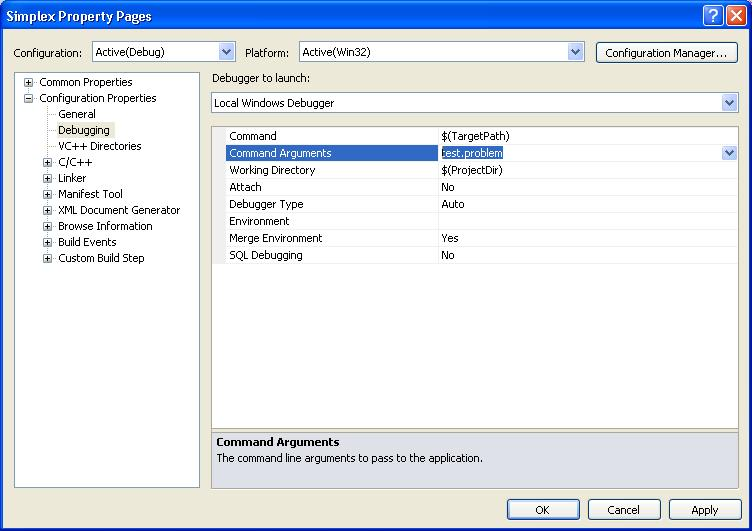
into 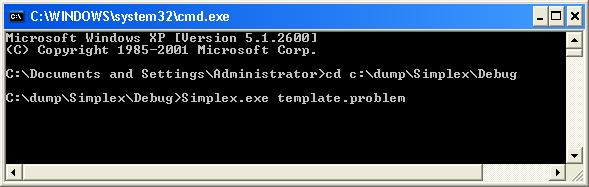 Alternatively in Visual Studio you can supply the same of the test problem as a command line argument. Right-click on the project, select Properties and set the command line argument in the Debugging section:
 Here are the test problems and their outputs:
test.problem
[code language="text"]
[METADATA]
name This is a small test problem
vars 5
[VARIABLES]
0 x1 inf
2.1 x2 4.1
23.4 x3 30
-2.2 x4 3
inf x5 104.3
[CONSTRAINTS]
1 3 1 1 0 < 43
[OBJECTIVE]
maximize 1 1 2 1 1
[/code]
Here are the test problems and their outputs:
test.problem
[code language="text"]
[METADATA]
name This is a small test problem
vars 5
[VARIABLES]
0 x1 inf
2.1 x2 4.1
23.4 x3 30
-2.2 x4 3
inf x5 104.3
[CONSTRAINTS]
1 3 1 1 0 < 43
[OBJECTIVE]
maximize 1 1 2 1 1
[/code]
 template.problem
[code language="text"]
[METADATA]
name Nome del problema
vars 10
[VARIABLES]
0 variable_1 0.2
0 variable_2 0.1
0 variable_3 1
-2 variable_4 1
-4 variable_5 1
inf variable_6 inf
inf variable_7 inf
-4 variable_8 1
4 variable_9 3
8 variable_10 inf
[CONSTRAINTS]
1 2 0 0 1 0 2 3 2 1 > 2
-2 0 0 0 1 1 1 2 5 1 < 10
[OBJECTIVE]
minimize 0 0 0 0 0 0 0 0 1 1
[/code]
template.problem
[code language="text"]
[METADATA]
name Nome del problema
vars 10
[VARIABLES]
0 variable_1 0.2
0 variable_2 0.1
0 variable_3 1
-2 variable_4 1
-4 variable_5 1
inf variable_6 inf
inf variable_7 inf
-4 variable_8 1
4 variable_9 3
8 variable_10 inf
[CONSTRAINTS]
1 2 0 0 1 0 2 3 2 1 > 2
-2 0 0 0 1 1 1 2 5 1 < 10
[OBJECTIVE]
minimize 0 0 0 0 0 0 0 0 1 1
[/code]
 small.problem
[code language="text"]
[METADATA]
name Problema semplice
vars 3
[VARIABLES]
0 x1 4
-2 x2 inf
-3 x3 232
[CONSTRAINTS]
1 3 4 > 0
0 0 1 < 1
1 2 0 < 2
[OBJECTIVE]
maximize 1 3 1
[/code]
small.problem
[code language="text"]
[METADATA]
name Problema semplice
vars 3
[VARIABLES]
0 x1 4
-2 x2 inf
-3 x3 232
[CONSTRAINTS]
1 3 4 > 0
0 0 1 < 1
1 2 0 < 2
[OBJECTIVE]
maximize 1 3 1
[/code]
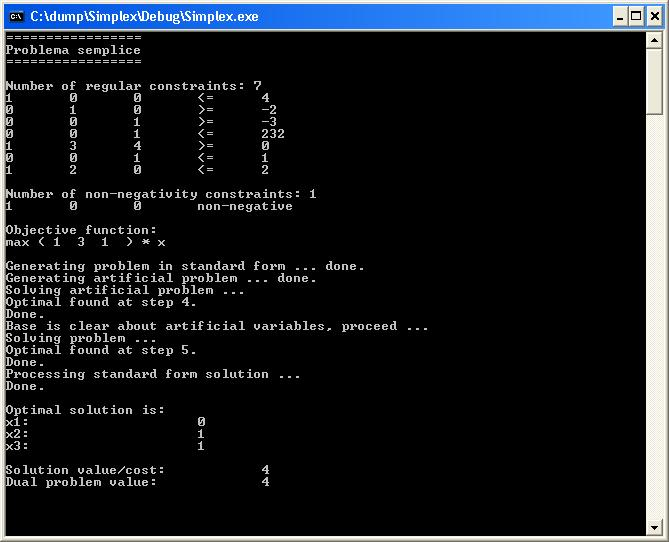 brunel.problem
Another example, this time from J E Beasley's Operational Research page at the Brunel University website:
http://people.brunel.ac.uk/~mastjjb/jeb/or/morelp.html
An example Linear Programming problem is formulated as follows:
x1 be the number of units of product 1 produced
x2 be the number of units of product 2 produced
where
[code language="text"]
x1, x2 <= 0
[/code]
The constraints are:
[code language="cpp"]
15x1 + 7x2 <= 20* 60 (machine X)
25x1 + 45x2 <= 15 * 60 (machine Y)
x1 <= 37 demand for product 1
x2 <= 14 demand for product 2
maximize 13x1 + 5x2 - 125
[/code]
This is encoded into the following brunel.problem file:
[code language="text"]
[METADATA]
name http://people.brunel.ac.uk/~mastjjb/jeb/or/morelp.html
vars 2
[VARIABLES]
0 x1 37
0 x2 14
[CONSTRAINTS]
15 7 < 1200
25 45 < 900
[OBJECTIVE]
maximize 13 5 -125
[/code]
The result upon running this is:
brunel.problem
Another example, this time from J E Beasley's Operational Research page at the Brunel University website:
http://people.brunel.ac.uk/~mastjjb/jeb/or/morelp.html
An example Linear Programming problem is formulated as follows:
x1 be the number of units of product 1 produced
x2 be the number of units of product 2 produced
where
[code language="text"]
x1, x2 <= 0
[/code]
The constraints are:
[code language="cpp"]
15x1 + 7x2 <= 20* 60 (machine X)
25x1 + 45x2 <= 15 * 60 (machine Y)
x1 <= 37 demand for product 1
x2 <= 14 demand for product 2
maximize 13x1 + 5x2 - 125
[/code]
This is encoded into the following brunel.problem file:
[code language="text"]
[METADATA]
name http://people.brunel.ac.uk/~mastjjb/jeb/or/morelp.html
vars 2
[VARIABLES]
0 x1 37
0 x2 14
[CONSTRAINTS]
15 7 < 1200
25 45 < 900
[OBJECTIVE]
maximize 13 5 -125
[/code]
The result upon running this is:
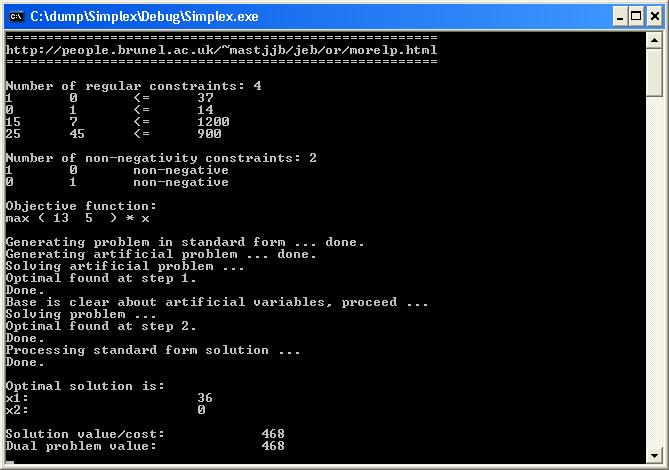 x1 = 36
x2 = 0
Giving the total profit as 13x1 + 5x2 - 125 = 13(36) + 5(0) - 125 = £343 as anticipated.
Visual Studio 2010 project downloadable from here:
https://www.technical-recipes.com/Downloads/Simplex.zip
x1 = 36
x2 = 0
Giving the total profit as 13x1 + 5x2 - 125 = 13(36) + 5(0) - 125 = £343 as anticipated.
Visual Studio 2010 project downloadable from here:
https://www.technical-recipes.com/Downloads/Simplex.zip
matrix.cpp then it compiled std::max just fine.
The project is able to load formatted problems in the form:
[code language="text"]
[METADATA]
name Simple problem
vars 3
[VARIABLES]
0 x1 4
-2 x2 inf
-3 x3 232
[CONSTRAINTS]
1 3 4 > 0
0 0 1 < 1
1 2 0 < 2
[OBJECTIVE]
maximize 1 3 1
[/code]
Defining your constraints is simple. A constraint of the form:
[code language="text"]
1 3 4 > 0
[/code]
Actually means that we want the value of
[code language="text"]
x1 + 3*x2 + 4*x3
[/code]
to be greater than zero.
An objective function of the form:
[code language="text"]
maximize 1 3 1
[/code]
Attempts to maximize the expression: x1 + 3*x2 + x3. Minimize is also available.
Running the programs requires that the name of the problem is provided. This application comes with three example problems: "small.problem", "template.problem" and "test.problem".
The sample problems can be run via the command line eg
Alternatively in Visual Studio you can supply the same of the test problem as a command line argument. Right-click on the project, select Properties and set the command line argument in the Debugging section:
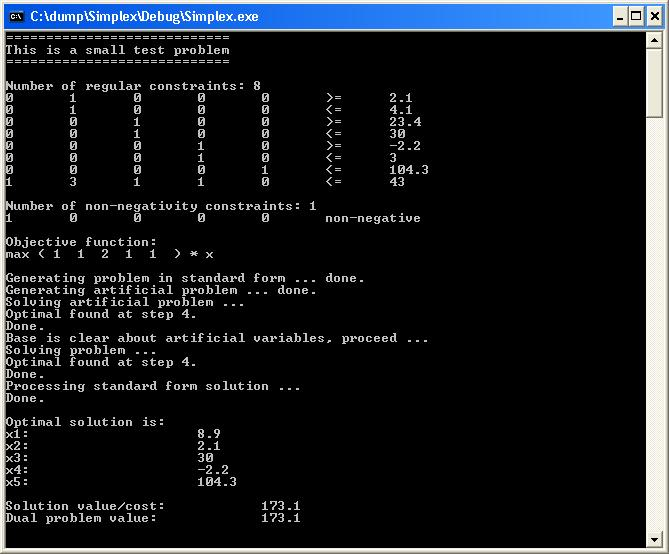
Here are the test problems and their outputs:
test.problem
[code language="text"]
[METADATA]
name This is a small test problem
vars 5
[VARIABLES]
0 x1 inf
2.1 x2 4.1
23.4 x3 30
-2.2 x4 3
inf x5 104.3
[CONSTRAINTS]
1 3 1 1 0 < 43
[OBJECTIVE]
maximize 1 1 2 1 1
[/code]
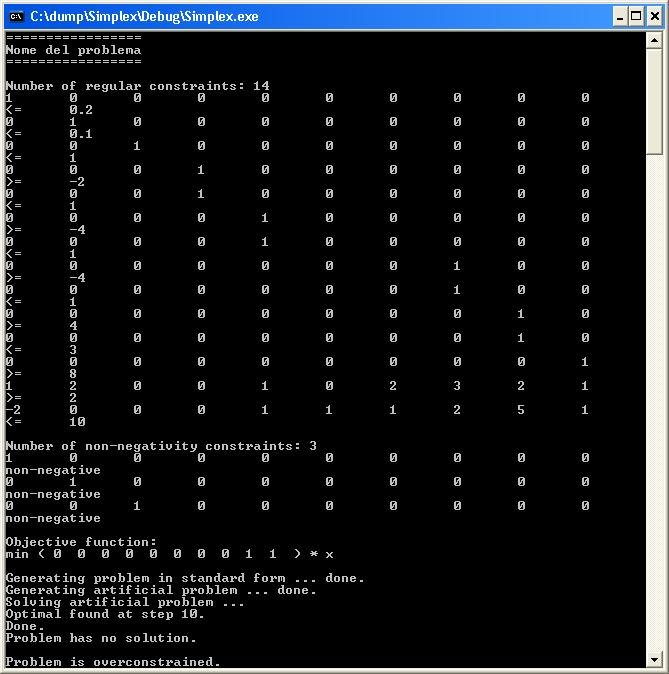
template.problem
[code language="text"]
[METADATA]
name Nome del problema
vars 10
[VARIABLES]
0 variable_1 0.2
0 variable_2 0.1
0 variable_3 1
-2 variable_4 1
-4 variable_5 1
inf variable_6 inf
inf variable_7 inf
-4 variable_8 1
4 variable_9 3
8 variable_10 inf
[CONSTRAINTS]
1 2 0 0 1 0 2 3 2 1 > 2
-2 0 0 0 1 1 1 2 5 1 < 10
[OBJECTIVE]
minimize 0 0 0 0 0 0 0 0 1 1
[/code]
small.problem
[code language="text"]
[METADATA]
name Problema semplice
vars 3
[VARIABLES]
0 x1 4
-2 x2 inf
-3 x3 232
[CONSTRAINTS]
1 3 4 > 0
0 0 1 < 1
1 2 0 < 2
[OBJECTIVE]
maximize 1 3 1
[/code]
brunel.problem
Another example, this time from J E Beasley's Operational Research page at the Brunel University website:
http://people.brunel.ac.uk/~mastjjb/jeb/or/morelp.html
An example Linear Programming problem is formulated as follows:
x1 be the number of units of product 1 produced
x2 be the number of units of product 2 produced
where
[code language="text"]
x1, x2 <= 0
[/code]
The constraints are:
[code language="cpp"]
15x1 + 7x2 <= 20* 60 (machine X)
25x1 + 45x2 <= 15 * 60 (machine Y)
x1 <= 37 demand for product 1
x2 <= 14 demand for product 2
maximize 13x1 + 5x2 - 125
[/code]
This is encoded into the following brunel.problem file:
[code language="text"]
[METADATA]
name http://people.brunel.ac.uk/~mastjjb/jeb/or/morelp.html
vars 2
[VARIABLES]
0 x1 37
0 x2 14
[CONSTRAINTS]
15 7 < 1200
25 45 < 900
[OBJECTIVE]
maximize 13 5 -125
[/code]
The result upon running this is:
x1 = 36
x2 = 0
Giving the total profit as 13x1 + 5x2 - 125 = 13(36) + 5(0) - 125 = £343 as anticipated.
Visual Studio 2010 project downloadable from here:
https://www.technical-recipes.com/Downloads/Simplex.zip


Comments
Post a Comment